ZURICH · 6 JUNE 2026 · TECHNOLOGY PANEL of the SWISS–LATVIAN SOCIETY
Technology as Opportunity. Security in the Baltic
With the support of Lars Gerspacher, Honorary Consul of the Republic of Latvia in Zurich, the Swiss–Latvian Society brought its community a singular occasion — a high-calibre panel on the twin theme of “Technology as Opportunity. Security in the Baltic”.
Two questions stood at the fore: what artificial intelligence makes possible, and what technology can do for Latvia’s economy and its security.
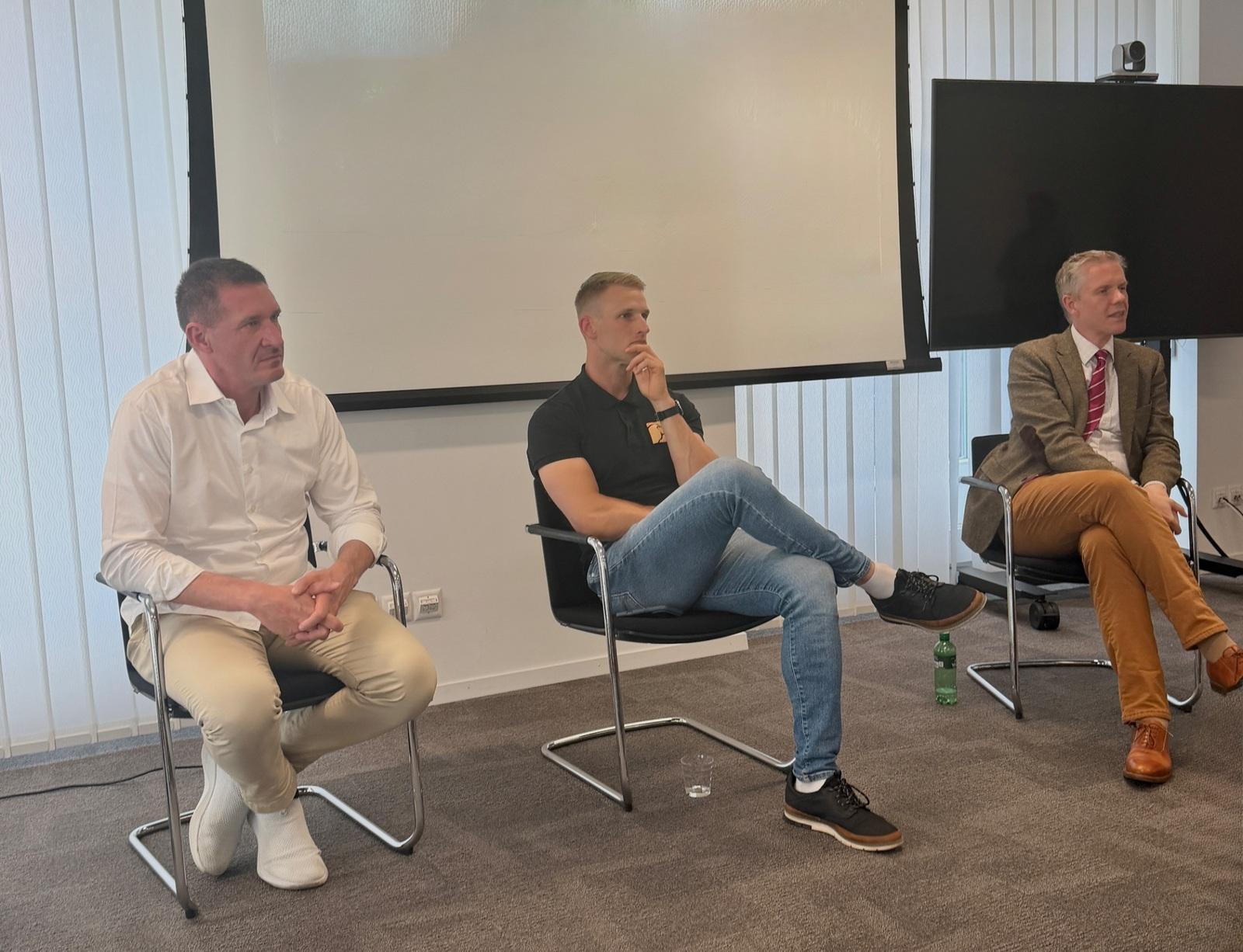
In Zurich. The afternoon’s speakers in conversation at the Swiss–Latvian Society’s dialogue, 6 June 2026.
The opening words were shared between the president of the Swiss–Latvian Society, Alain Schorderet, and Honorary Consul Lars Gerspacher. A thorough look at AI and cyber-security risks through the regulatory lens was then opened by Christophe Tummers, Group Chief Data Officer of Société Générale.
THE TALKS and DISCUSSIONS in DETAIL
AI on the Test Bench
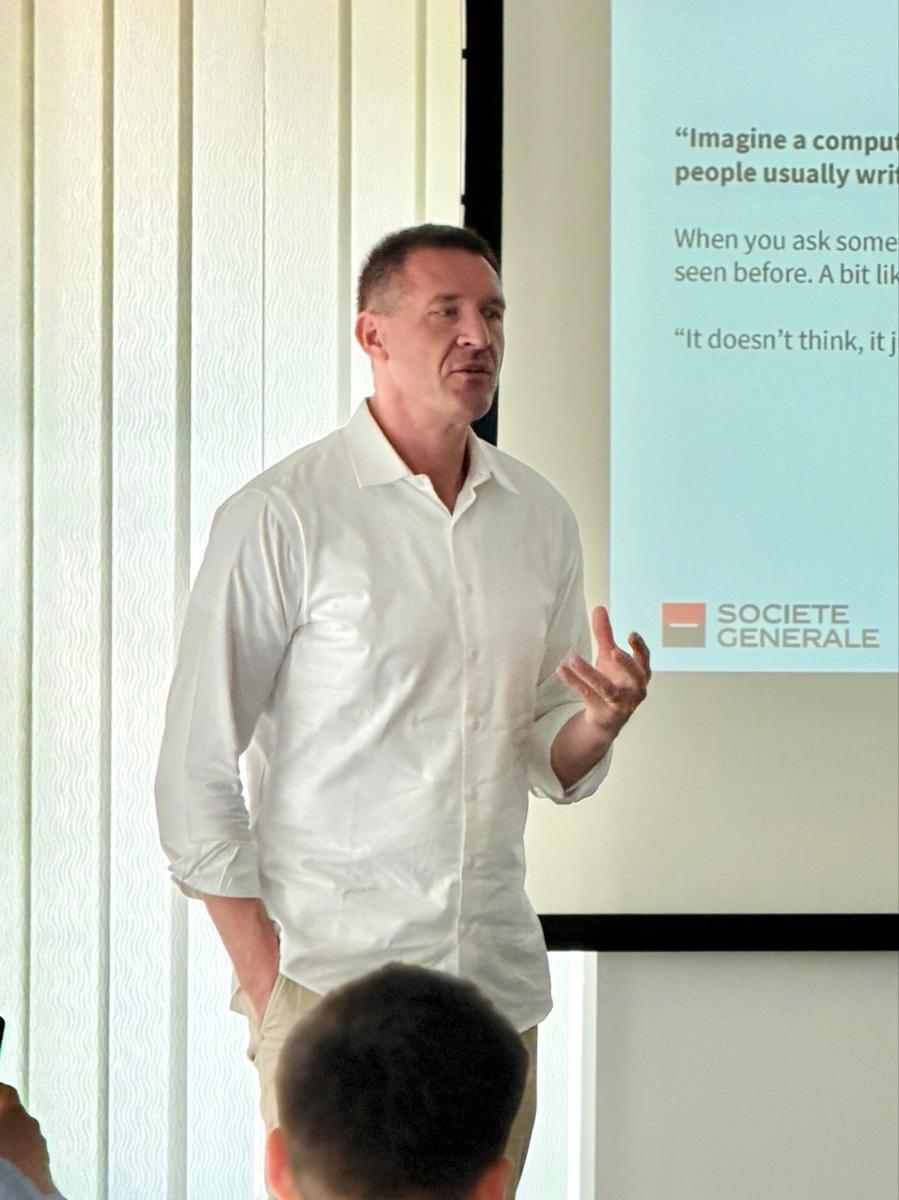
Christophe Tummers, Société Générale. He demystifies large language models.
From the talk. “LLMs, the EU AI Act & AI Risk” — the regulatory framework Tummers set against Europe’s pace of innovation.
Christophe Tummers, Chief Data Officer of Société Générale, set out after three decades in banking to take some of the mystique out of artificial intelligence. A large language model, he told the room, is something like a very well-read assistant who writes quickly. It knows nothing, and in composing its answer it does not think but produces “the most plausible answer on the basis of what it has learnt”. From there he turned to why this matters now, building the case on Europe’s own paperwork. He worked through the EU AI Act, whose pyramid runs from unacceptable risk down to minimal, together with the ever-lengthening list of harmonised standards and compliance deadlines reaching into 2026 and 2027. He then set it against the reality check from Mario Draghi’s report: on that account the Union passed some 13,000 legal acts in five years, against roughly 3,500 at US federal level, while a chart on AI patents assigned China around 61 per cent of those granted, the United States about a fifth, and the EU together with Britain barely 2 per cent. The point — Europe writes rules at a pace it long ago ceased to match in invention. He was not wholly gloomy: in his own encounters with the Commission and Parliament on simplification he had, he said, been pleasantly surprised, and he credited Europe with being good at integration, infrastructure and rule-setting.
His prescription was scale, and his yardstick was deliberately American. Only eighteen banks today carry the designation of global systemically important institution, and Société Générale is one of them. That, he said, is the Champions League of banking, and the mistake of European houses is to measure themselves against one another. His own message to staff, repeated daily, is to look instead to Goldman Sachs and JPMorgan — on the reasoning that even half of what the American houses achieve would still make Société Générale the best in Europe. The road to that scale runs through consolidation, and the future he sketched for European finance was one of mergers, of fewer and larger institutions able to afford the very technology the rest of his talk had just declared indispensable.
Europe is falling behind, he argued, not because its resources or institutions are weak, but because everyone else is moving faster; as the pace-setters he cited Singapore and Hong Kong. Europe must become far more aggressive on technology, he warned, and not capitulate to the dominance of the United States and China — while keeping a sober, positive view of the progress still possible.
“Europe will need a larger and more integrated capital market than the one we have today.”
CHRISTOPHE TUMMERS · GROUP CHIEF DATA OFFICER, SOCIÉTÉ GÉNÉRALE
Drawing a sharp line between large language models and “AI” in general, Tummers was at his most concrete on cyber risk — and his most unsettling: at a bank, AI works on both sides of the ledger. It speeds up existing attacks and turns days into minutes, and it makes high-quality phishing, identity forgery and real-time deepfakes cheap enough to target banks and their customers at scale. It also opens new ground; the watchwords are: AI agents as fresh points of entry, prompt injection that can let internal data leak out unnoticed, and a growing dependence on third-party models and datasets that becomes a supply-chain risk in its own right.
Anthropic’s new model, Mythos, he said, had shown it could find software flaws on its own and write working exploits at machine speed; the figure on his slide was 271 vulnerabilities identified in the Firefox browser, 181 of them successfully exploited. What troubled him most was not any single vulnerability but the model’s ability to chain together small weaknesses, harmless on their own and scattered across many millions of lines of code, into a single malicious sequence — and the time to prepare for it, he said, is short.
For an audience sold on AI as an opportunity, this was a deliberate reminder that the same capability is available to the other side — and that the institutions least able to fund a defence are precisely the European ones he had spent the previous ten minutes criticising.
His warning proved well-aimed. Three days later, on 9 June, Anthropic released Fable 5, a Mythos-class model that it said it had made safe for general use, together with an access-restricted upgrade, Mythos 5, billed as the most cyber-security-capable system in the world. The model class he had invoked was thus pressing, within days, into the very market he had just declared unprepared. Yet what followed only sharpened the point. On 12 June the US government, citing national security, directed Anthropic by order to block access to Fable 5 and Mythos 5 for every foreign national — inside and outside the United States, its own foreign staff included. Since these users could not be separated out in real time, Anthropic shut down both models for all customers worldwide and began issuing refunds; the remaining models, including Opus 4.8, were untouched. The most capable model the company had ever shipped had thus vanished three days after launch — stopped not by a competitor but by government order. And that is precisely the lesson for Europe: if even a top-tier model built in the United States can be shut down overnight by Washington, then sovereign access to an equally strong European model — one that a contender such as Mistral would have to supply — is no longer a nice-to-have but a necessity.
Security as an Economic Question
Prof. Dr. Marcus M. Keupp, who spoke in German, was blunt about the Baltic’s defensive posture — and Latvia’s in particular — and its access to resources. The new military edge no longer lies in the heavy, fossil-fuelled platforms of the past, he argued, but in lighter, software-defined systems the continent is capable of building, and war is the trigger: Ukraine today, the Cold War before it, each accelerating invention as peace never does. The long peace dividend, which let Europe spend too little and build too little, is on this reading over. It was the optimistic turn in an otherwise sober talk, one that also laid bare how a continent tying its industrial renewal to the spur of a war on its doorstep is building on ground it does not control.
Latvia’s Pitch — and Its Limits
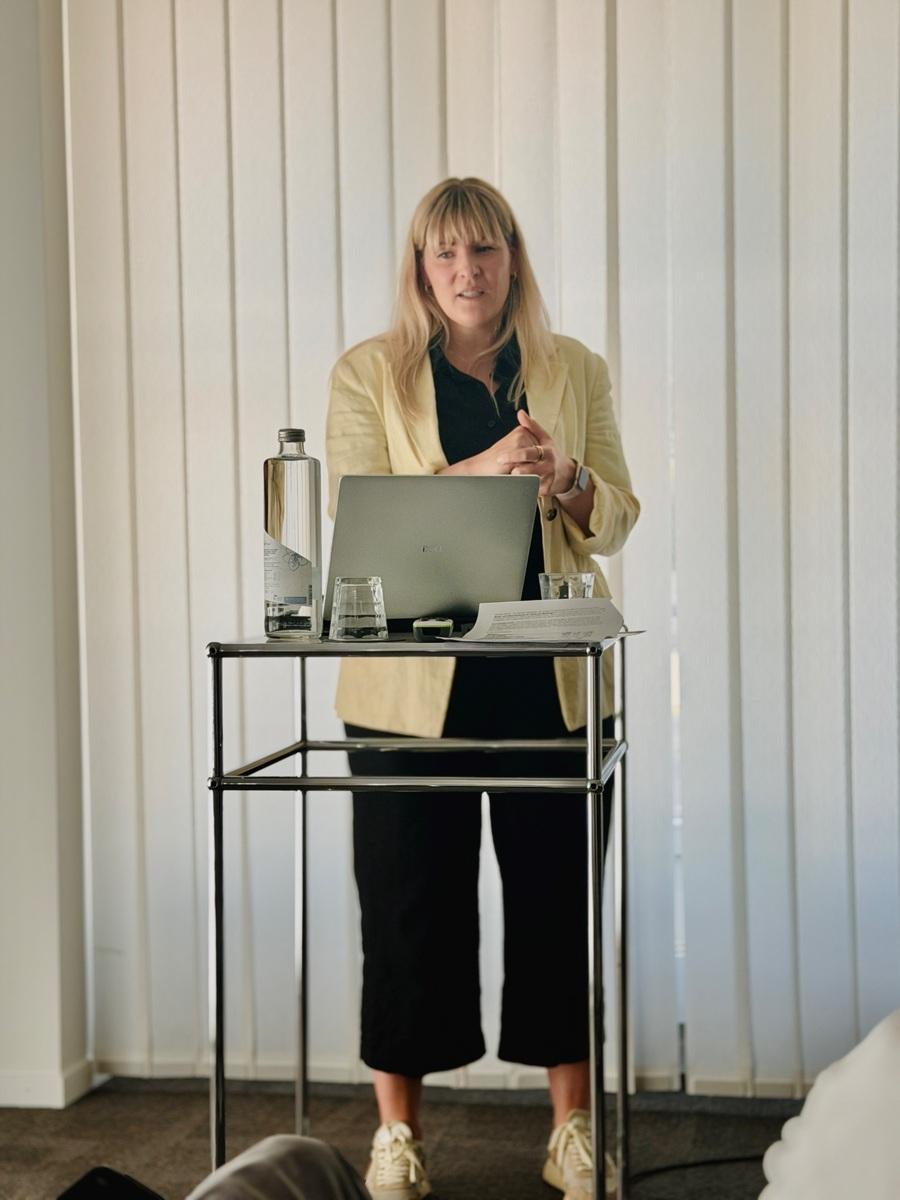
Alise Pīka-Ozola. Latvia’s case from Geneva: photonics, deep tech and, above all, drones.
Alise Pīka-Ozola, who manages economic relations from the Latvian mission in Geneva, reported that Latvia is not trying to keep up everywhere; it chooses narrow fields. Photonics, deep tech and, above all, drones — an ecosystem that has grown quickly since 2022 and now spans optics, batteries and components. The substance behind it holds up: a real depth of core AI competence and deep-tech talent for the size of the country, returning expertise, the region’s largest drone testing range with flights cleared to around six kilometres, and some 12,000 Latvian drones that went to Ukraine in a single year. She listed civilian applications in logistics, medical supply, and search and rescue, and described funding programmes meant to attract foreign manufacturers. Her forward-looking reading is the one to take seriously — that defence technology could now be the growth engine of the Baltic economies, and that the region’s potential, sector by sector, is greater than its size would suggest. For prospective investors she recommended the following orientations: Riga for drones and low-cost access to the EU market, closely tied to the Nordics; Vilnius for life sciences; Estonia for digital and finance.
She was honest enough to concede that some companies choose Latvia for reasons that have little to do with strategy — the climate, the forests and the coast, the food, the simple pleasure of building a life there. It is a charming argument, and yet in today’s economy it is rarely the decisive factor. Smart capital does not follow the area’s best restaurant list; it follows political stability, a region’s real capacity to develop, a government open to the pace at which firms truly scale, financing mechanisms that work without draining away into bureaucracy, the cost of living, affordable access to talent, and the depth and breadth of research talent — and it asks bluntly whether the technology has left the test bench or is still being trialled on it. None of this diminishes the pitch: selling Latvia’s capabilities matters enormously to its growth, while neighbours compete to give investors easier access on attractive terms — Prof. Dr. Keupp pointed to Lithuania as an example of achieving what seems impossible elsewhere. Putting Latvia on the map is exactly what the country should do more of. The harder task is delivering everything the brochure describes.
A reality check can be set out in two examples below. First: a state that can send twelve thousand drones to a war next door was, weeks earlier, unable to bring down two that strayed over its own territory — a failure that cost the government its office. Scaling an export industry and standing up a working defence are not the same feat, and it is the second that war is now testing. The second example concerns money. Funding rests largely on public and European support — that is, on the very channel most exposed to a caretaker government and an election a few months away — while the capital that moves at the pace defence actually demands is private, American and national. A European signal nonetheless points the right way: in April the European Investment Bank (EIB) agreed with the Ministry of Economics and the LIAA (Latvia’s Investment and Development Agency) to advise Riga on how to turn its start-up base into scalable companies; a roadmap is planned by year’s end through the InvestEU Advisory Hub. This is above all validation and capacity-building across eight sectors, defence and cyber-security included: the EU’s own bank lends its credibility to a frontier ecosystem and helps design the instruments that private money later follows — useful and emphatically European, even if it is advice rather than the cheque the moment ultimately needs.
The Will to Build
The sternest voice on the defence-tech side was Prof. Dr. Marcus M. Keupp, head of the Department of Military Economics at ETH Zurich. Small countries, he argued, can count for far more than their size suggests if they specialise, and the Baltic already serves as an operational and logistical hub for certain technologies, closely tied to Germany and Britain. He warned against treating drones as toys rather than as part of a broader military capability. He advised investors to watch the fundamentals: energy security, the resilience of the power grid, and the case for keeping supply chains in the country while relying on small, fast firms rather than large contractors. Value creation, he said, is possible only through technological development, and a region living off an old lead will at some point stop creating value altogether.
He saw early signs of a rethink about what should drive technology to scale. The constraint, he insisted, lies not in resources but in mindset: the Baltic and Europe have everything they need yet cling to old thinking, and the empowerment to act is missing. His conclusion was a call to build. Enough hesitation, he said; let us create the whole thing — the defence, the technologies and the business models together.
“Value creation is possible only through technological development.”
Prof. Dr. MARCUS KEUPP · MILITARY ECONOMIST, ETH ZURICH
What Europe lacks, one speaker put it squarely, is the conviction to draw a line, to say “this is our border” and to defend it with the seriousness it reserves for regulation.
Fortification today, he argued, means not physical barriers but a drone-defended kill zone. He pointed to Poland, already building its “Eastern Shield” along the border, and to Ukraine, which has shown how a formidable defensive effect can be achieved with modestly funded means. What the Baltic states need is the inner readiness to stand up and say, “this is the border” — and then to build it. His warning was unsparing: “You must build this border, or in ten years you will no longer be here. That is the only language the Russians understand.” Defence, he added, begins like sport in the mind.
The thread running through all of this was independence. A country that lets itself be pressured from outside, he argued, is not truly able to defend itself, and the path to real independence runs through energy. Being poor in raw materials is precisely what forces a country to innovate; true independence comes from green energy, while dependence on fossil sources is the central vulnerability. He pointed to gas storage — for one of the largest stores sits in Latvia — and to the still-unresolved question of how to handle wind and solar power.
How Defence Technology and Infrastructure in the Region Can Be Financed
The innovation story Alise Pīka-Ozola described runs largely on public and pooled funding. The LIAA, the state agency under the Ministry of Economics, channels grants, incubation and acceleration into strategic technology, pooling public money and EU funds with private capital, and much of it — such as regional development funds and the post-pandemic Recovery and Resilience Facility — is European. The deep-tech figures are good.
I looked up the figures. Latvia counts some 569 active tech start-ups, up by about 11 per cent on the previous year, employing around 5,100 people, with deep tech making up the largest rounds of 2025 — the wind-turbine robotics firm Aerones alone raised 54 million euros.
A pipeline that depends on EU co-financing and a functioning ministry is, however, vulnerable precisely when the government is in caretaker mode and an election is a few months away. A coalition brought down over a drone is in no position to write large, long-term cheques for the next drone company.
The same problem applies, more seriously still, to defence, and here the panel mostly looked the other way. In 2026 Latvia will spend almost 5 per cent of GDP on defence, one of the highest shares in NATO, and the Baltic states pressed their allies to this level at the summit in The Hague. The question I could not set aside was where the fast money and the credible striking power actually come from. Prof. Dr. Keupp’s answer was perfectly blunt: the source has so far been American and bilateral, not European. United States Foreign Military Financing and the Baltic Security Initiative now let Latvia buy layered air defence from American suppliers, and the US Congress has just approved a further 200 million dollars for Baltic assistance; Washington’s weight in the region still runs through its commands and bases in Germany. Germany itself is deploying a permanent combat brigade to Lithuania, its first such posting abroad since the Cold War. Against this, the European Union’s instruments — defence bonds, joint borrowing and a forthcoming defence white paper — look larger on paper but move at the pace of twenty-seven governments. When a drone can cross a border faster than a procurement cycle, those responsible will go on reaching first for Washington and Berlin, whatever the European words on stage.
Brussels received a split verdict: useful for cross-border projects and infrastructure, less so when it regulates national economies. The real customers, he suggested, are closer to the front. US forces around Kaiserslautern in Germany were described as well resourced and keen to win hearts and minds, and as ready to commission almost any technology that helps hold the front; the American supply chain — from Dülmen in Germany to the larger new materiel depot in Powidz in Poland, with the forward presence of V Corps — counts as the logistical backbone. Poland is the model: it offers land, logistics and ready-built facilities so that the Americans come — a pitch made easier by President Trump’s well-known affection for Warsaw.
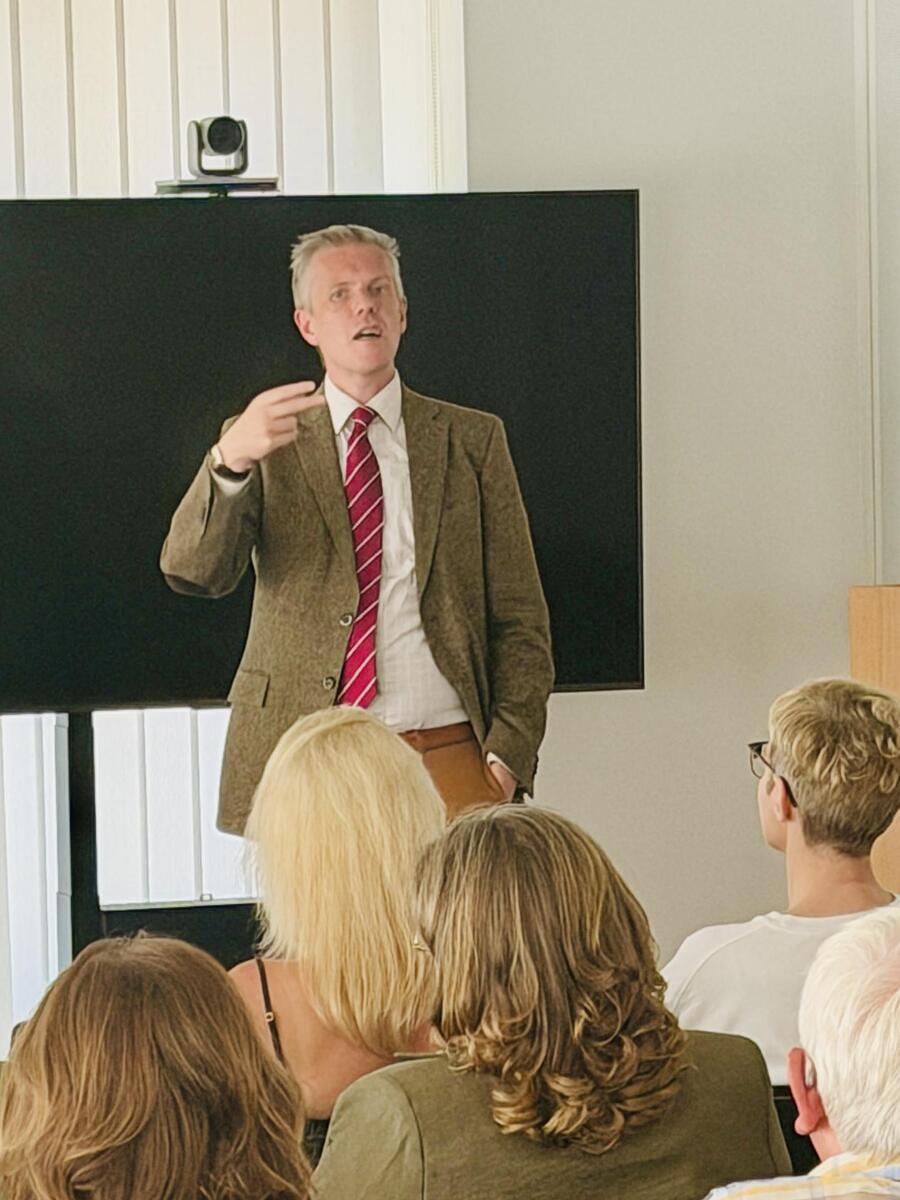
Prof. Dr. Marcus Keupp. He got specific about where the demand for defence — and the money — actually lie.
For Latvia, the proposal is to bring in Ukrainian developers and manufacturers, to pair the next generation of battlefield technology with local production, and to listen to refugees about the reality of war. Ukraine, Keupp said, has something to teach Europe.
The Human Factor
The most down-to-earth contribution of the afternoon came from Reinis Krēgers, the athlete who has built a movement-coaching app with Czech, Ukrainian and Swiss partners. The lesson that has guided him, he said, is that in the chaos AI brings, human soft skills become more important — the judgement that software cannot supply is what endures. Technology counts, but so do the people who decide what to do with it.
Finance has gone from gatekeeper of defence to its enabler, and yet the fastest money remains American and national; strategic technology is now Europe’s declared priority, and energy and AI alike are becoming questions of independence.
Latvia’s tech offer comes with conditions. The talent is real, the niches are well chosen, and the EU, Ukraine and Switzerland are natural partners in testing, financing and scaling. Yet a plan made urgent by a war next door, one that needs defence from Washington and draws its funding from Brussels, is a plan guaranteed in large part by others. Whether a confident afternoon in Zurich turns Latvia into something it actually controls itself will be decided where it must be — in Riga.
By Liene Daktina · for the Swiss–Latvian Society
Produced as a follow-up report on the event for a specialist audience. The speakers’ remarks are paraphrased from the public programme; the political, financial and security-policy context draws on public reporting as of June 2026. The author’s personal observations remain independent of the Swiss–Latvian Society and of the speakers. The figures cited are drawn from publicly available sources and from the slide information provided by the speakers.